The New Private Markets Playbook
Turning access to private markets into durable, compounded growth.

With football season starting back up, coaches are scrutinizing their playbooks and making final adjustments for the year ahead. A playbook is a dynamic guide designed to maximize a team's talent and resources. In our view, the same principle applies to private-market investing: a thoughtful portfolio plan should make full use of all the tools available to investors.
Access Is No Longer the End Goal
Private markets were originally designed for institutions, and for decades they remained largely inaccessible to individual investors. As the industry has evolved and barriers have receded, access has become increasingly commonplace through wealth-focused solutions and significant industry investment. Semi-liquid and evergreen structures now hold more than $500 billion and continue to grow, extending institutional-grade access once reserved for endowments and pensions.
The door is open. The challenge now is building a portfolio that uses the broader opportunity set effectively.
How to Measure Success
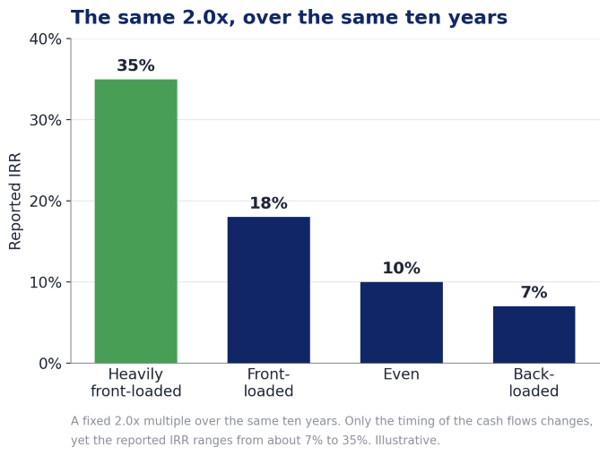
Drawdown funds, the closed-end structures that typically call capital over a three- to five-year investment period and harvest investments over years five to ten, have long been a core tool for institutional investors. General partners often market performance using net internal rate of return (IRR). IRR can be a useful metric, but it should not be viewed in isolation.
IRR rewards the timing of cash flows, not simply the size of the outcome. It is therefore not directly comparable to the return an investor sees in a traditional public-market investment. For example, assume a fixed 2.0x multiple over a ten-year period. Depending entirely on when capital is called and distributions are received, the reported IRR can range from roughly 7% to 35%.
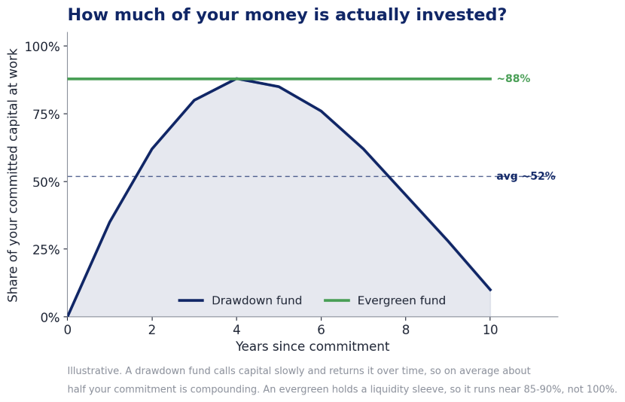
This distinction matters because drawdown funds generally call and harvest capital over time, meaning average invested capital may be closer to half of an investor's commitment. Capital not yet called may sit in cash or short-duration investments, rather than in the underlying private-market strategy. By comparison, an evergreen fund may keep approximately 85% to 90% of capital deployed.
For this reason, we believe investors should focus on two complementary measures: the multiple on invested capital (MOIC), which captures the magnitude of value creation, and the realized compounded return on the portfolio as a whole.
Pair Operational Complexity with Alpha Potential
None of this makes drawdown funds obsolete. In parts of the market, a closed-end structure remains the most efficient vehicle. Many smaller, high-performing managers are capacity constrained and may never appear in large evergreen fund-of-funds. Accessing these managers can require a direct commitment to their funds.
Some strategies also benefit from phased capital deployment, creating value by calling capital as specific opportunities emerge rather than keeping it fully invested from day one. Used deliberately, drawdown structures can provide access and alpha that an evergreen core may not be able to replicate on its own.
Co-investments and direct deals can offer additional alpha potential, but these opportunities are episodic and difficult to forecast. That makes disciplined liquidity and cash-flow management essential.
Execute the Game Plan
We believe private-market portfolios should be built around a diversified core. Institutions often construct portfolios across numerous vintage years or use secondary funds to build diversification retroactively. In many respects, they are recreating, using more resources and line items, the diversification and capital efficiency that a well-underwritten evergreen fund can provide.
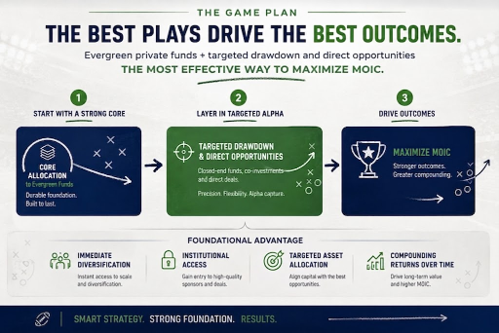
A quality evergreen fund can provide three benefits at once: institutional-grade access, immediate vintage and manager diversification, and high capital efficiency. Once that foundation is established, investors can selectively layer in complementary drawdown funds, co-investments, and direct opportunities where the potential reward is compelling.
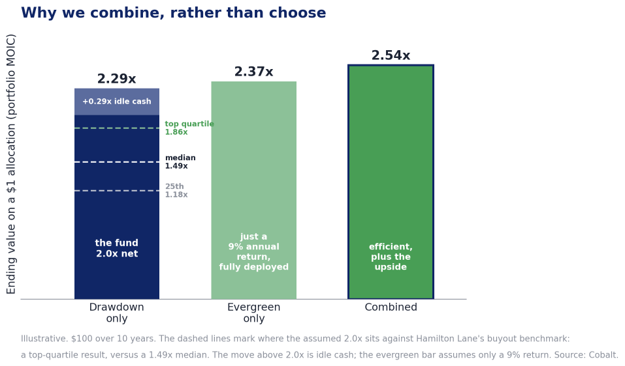
Our framework is straightforward: use the evergreen core as the foundation, then add targeted opportunities where we believe there is a credible path to a 2.0x net MOIC or better, and where the expected pace of value creation is sufficient to out-compound the core over the same period.
Investors should also be realistic about the hurdle. A 2.0x net outcome in buyouts represents a top-quartile result. According to Hamilton Lane, the top-quartile line is approximately 1.86x, compared with a 1.49x median. Access to high-quality managers, and the ability to underwrite them effectively, is therefore critical.
For investors who do not have the access or underwriting capabilities required to identify the strongest closed-end managers, we believe a well-selected evergreen portfolio may offer a more efficient path to the desired outcome with less manager-selection risk.
At the same time, we believe genuine alpha opportunities exist in the closed-end market. That is why we view the 'evergreen versus drawdown' debate as overly simplistic. Used in isolation, either structure can leave return potential on the table. Used together, with disciplined manager selection and deliberate sizing, the two can complement one another, improving capital efficiency and increasing the opportunity to compound returns over time.
— Jon Autry, CAIA
Director of Private Investments
EQV Advisory
Methodology and DisclosuresThe illustration. Figures reflect a hypothetical $100 allocation over a ten-year horizon. The evergreen core is assumed to earn a 9.0% annual net return and to remain fully deployed; in practice these funds hold a liquidity sleeve and run roughly 85% to 90% invested. Capital in reserve or awaiting deployment earns an assumed 4.0% cash-like return. Portfolio MOIC is ending value divided by the $100 committed, and fund-level IRR is calculated on the drawdown sleeve's called and distributed cash flows.Drawdown-only scenario. The full $100 is committed to a single closed-end fund that calls capital over years one to four ($25 / $30 / $25 / $20) and distributes over years six to ten ($30 / $40 / $50 / $45 / $35), a 2.0x net multiple on called capital. Uncalled and returned capital sits in reserve at the cash rate.Combined scenario. The full $100 is invested in the evergreen core. A $40 commitment is made to a drawdown sleeve; that $40 is not held in cash but remains in the core and is drawn as the sleeve calls capital over years one to four ($10 / $12 / $10 / $8). The sleeve returns a 2.0x net multiple, distributing $80 over years six to ten ($12 / $16 / $20 / $18 / $14), which is reinvested into the core, while the remaining core capital continues to compound.Benchmark. Quartile figures are buyout net multiples (TVPI) from the Hamilton Lane Private Markets Benchmark, via Cobalt, across approximately 2,053 funds, as of March 31, 2026: 25th percentile 1.18x, median 1.49x, and a top-quartile line of 1.86x.Important disclosures. For illustrative and educational purposes only. This material is not investment, legal, tax, or accounting advice and is not an offer or solicitation to buy or sell any security or to pursue any strategy. Performance is completely assumed and not tied to any EQV product or service. The results are hypothetical and model-based; hypothetical results have inherent limitations, are prepared with the benefit of hindsight, do not reflect actual trading or market conditions, and may not reflect all fees, expenses, and taxes. The assumed returns, multiples, and cash-flow timing are hypothetical inputs selected to illustrate a structural relationship; they are not forecasts, projections, or guarantees, and actual results will differ, potentially materially. Evergreen and drawdown structures carry different fee arrangements and liquidity terms, captured here only through the assumed net returns and multiples. Private-market investments involve significant risks, including illiquidity, long holding periods, the use of leverage, and the possible loss of all invested capital. MOIC and IRR measure different things; IRR is sensitive to the timing of cash flows and embeds a reinvestment assumption that may not be achievable. Sources: Morningstar and PitchBook; PitchBook forecasts; Deloitte; Hamilton Lane Private Markets Benchmark via Cobalt. Growth figures approximate.EQV Advisory is an investment adviser registered with the U.S. Securities and Exchange Commission. Registration does not imply a certain level of skill or training. More information about EQV’s investment advisory services can be found in its Form ADV Part 2 and/or Form CRS, which is available upon request.